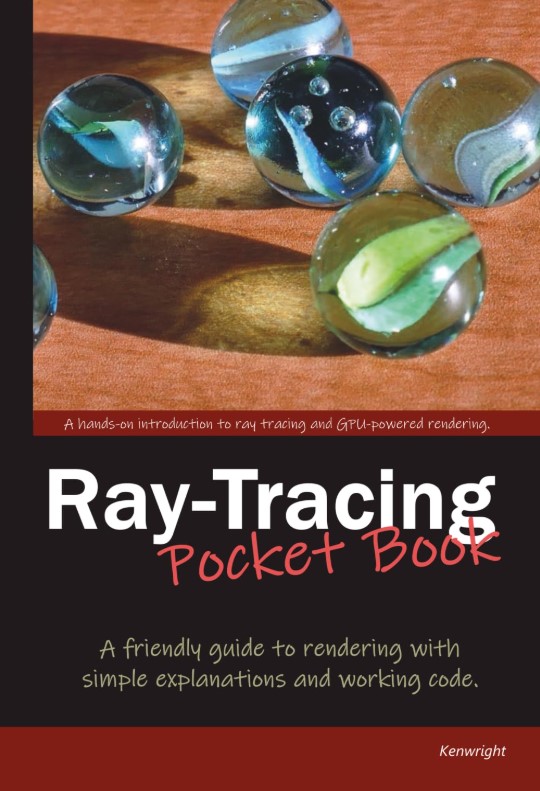
An illuminating journey into ray tracing, "Ray-Tracing Pocket Book (Paperback)" explores its profound influence on the intelligent systems. With clarity and enthusiasm, this essential read delivers fresh perspectives and actionable insights that inspire curiosity and spark meaningful progress.
Readers will find themselves motivated by the book’s clear explanations, thoughtful examples, and forward-thinking perspective. The author's passion for the subject shines through every chapter, offering readers a refreshing mix of technical rigor and creative inspiration. This book stands out for its uplifting tone and empowering approach to rendering, making even the most complex topics feel approachable and exciting.
The author's mastery of rendering is evident throughout. Every chapter feels like a masterclass.
The diagrams and visuals were top-notch—clear, purposeful, and genuinely helpful in understanding the concepts.
July 12, 2026
The balance between rigorous research and relatable anecdotes makes this book feel both credible and deeply personal.
The integration of storytelling and data was masterful. It made the content both credible and compelling.
July 15, 2026
I recommended this book to my entire team—and the results were immediate. Our workflow is sharper, our thinking more strategic.
Same here. It’s rare to find a book that’s both intellectually rigorous and emotionally engaging—this one nails it.
July 19, 2026Stay updated with the latest in tech literature
Browse 100+ of the most exciting new LGBTQ books out in 2026 (so far), including M/M romance, trans sci-fi, sapphic fantasy, and more....
Read MoreMoonshot AI’s 2.8-trillion-parameter Kimi K3 raises China’s open-model ambitions while posing major infrastructure and cost questio The post Moons...
Read MorearXiv:2607.16114v2 Announce Type: replace-cross Abstract: It is well-known that combinatorial circuits are modeled mathematically by string diagrams ...
Read MoreEnhance your reading and learning experience
Create a dedicated reading space with good lighting and minimal distractions.
Use a pointer or your finger to guide your eyes. This can increase reading speed by 25%.
Rubber Duck Debugging: explain your code line by line to an inanimate object.
Follow the 20-20-20 rule: every 20 minutes, look at something 20 feet away for 20 seconds.
Organize books by color for visual appeal or by genre for practical access.
Take brief notes after each chapter. Summarizing helps cement knowledge.
Sarah Johnson
Professional ReviewerThis book didn’t just inform—it inspired me to rethink how I approach 3D in my own work.
July 14, 2026